Carbon dioxide is a greenhouse gas that is believed to raise global temperatures. In the past 200 years, carbon dioxide has increased by 35 percent. Scientists are working with natural resource managers to better understand how plants respond to changes in atmospheric carbon dioxide to maximize plant productivity.
Posted in Climate, Plants | Tagged carbon dioxide, Climate, plants |
Eco-labeling is a new certification program similar to the organic label, but goes beyond the organic concept by reflecting new land management practices for the entire farm ecosystem, including non-crop lands. With funding from USDA’s Cooperative State Research, Education, and Extension Service (CSREES), a team of scientists, growers and environmentalists in Wisconsin developed the “Healthy Grown” label to reflect this land management practice to promote balanced agricultural management and support broad ecosystem health.
Posted in Plants | Tagged biodiversity, Healthy Grown, organic |
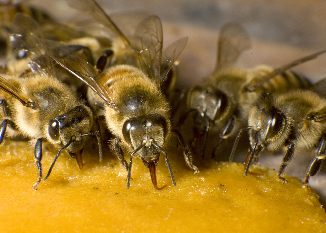 Colony Collapse Disorder (CCD) has been linked to the 40-60 percent decline in America ‘s honeybee populations whose pollination is valued at $15 billion annually to U.S. agriculture. Researchers at SAFE R&D, LLC, are trying a new approach to this problem – a bee smoothie – to improve honeybee healthy by improving their diet.
Posted in Plants | Tagged colony collapse, honeybee, nutrients |
Important cereal crops, such as wheat and barley, are susceptible to a fungus, called Fusarium graminearum that is responsible for head blight disease. Researchers recently sequenced and annotated the genome of this fungus, shedding light on how it is able to survive in rapidly changing environments. The new knowledge could lead to new ways to combat the harmful pathogen, which has caused more than $10 billion in crop losses over the past 10 years.
Posted in Plants | Tagged fungus, fusarium graminearum, head blight |
 EarthSpin