Feeds:
Posts
Comments

Archive for the ‘Genetics’ Category

Cyst nematodes are menacing, microscopic roundworms that infect and feed on the root cells of many important agricultural crops. One species of cyst nematode, Heterodera glycines, feeds on soybean crops, resulting in up to $1 billion in crop loss in the United States each year. Recent research, funded by USDA’s Cooperative State Research, Education, and Extension Service (CSREES), is uncovering the mechanisms used by this nematode to weaken the plant’s defense system.

Recent work by scientists at the University of Missouri (UM) and Iowa State University (ISU) is featured on the cover of the March issue of the journal Molecular Plant-Microbe Interactions. The results from their studies may lead to more effective management tools to combat the agricultural pest and protect this vital U.S. crop.
(more…)

Read Full Post »

Screen shot 2014-06-09 at 4.00.38 PMWhile consumers are lately hearing a lot about corn-based ethanol, a group of scientists advocates using mustard as a lotion, paint, biodiesel additive and lubricant.

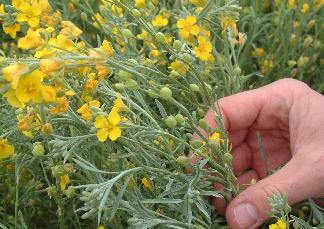
With funding from USDA’s Cooperative State Research, Education, and Extension Service (CSREES), a research group in Texas, Arizona and Illinois is looking at Lesquerella, a member of the mustard family, as a potential source for energy.

(more…)

Read Full Post »

Screen shot 2014-06-09 at 3.54.41 PMResearch into the hormone that controls the growth of insects has led to a new approach to treating human disorders, including hypertension.

The juvenile hormone in insects controls the different stages of development. Scientists have developed insect growth regulators that mimic juvenile hormone as a form of biologically based insect control. With funding from USDA’s Cooperative State Research, Education, and Extension Service’s (CSREES) National Research Initiative (NRI) program, a team of scientists in California examined how juvenile hormones affect metamorphosis, which in turn led to the unexpected discovery of a new approach to treat high blood pressure and other disorders in humans.

(more…)

Read Full Post »

Mad cow disease is a fatal neurodegenerative condition in cattle that is related to the human form of a disease that has caused the deaths of nearly 200 people worldwide. Currently, testing for this disease in cattle is a lengthy process that only occasionally results in a correct diagnosis.

With funding from USDA’s Cooperative State Research, Education, and Extension Service (CSREES) National Research Initiative (NRI), scientists in New York created a new device that may provide a faster, easier, and more reliable way to test for mad cow disease, also known as bovine spongiform encephalopathy (BSE).

(more…)

Read Full Post »

« Newer Posts - Older Posts »