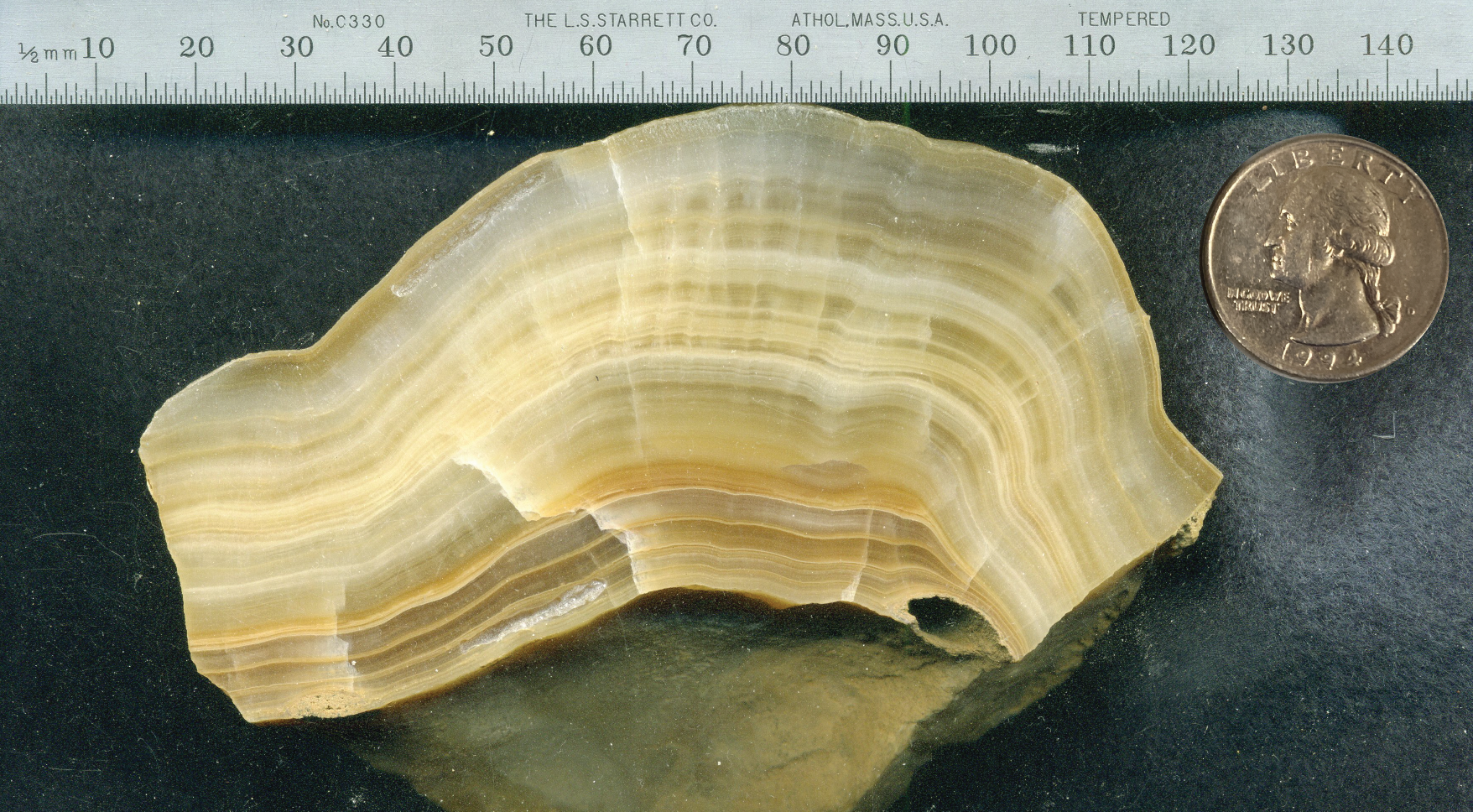
A speleothem has revealed rapid periods of warming across the interior of the continent during the last glacial period, corresponding to similar events recorded in Greenland ice.
Numerous climate records illustrate how temperature and precipitation have fluctuated over long periods of Earth’s history. Advances in technology have improved the resolution of these records, revealing episodes of short-term climate variability. A new record, obtained from a tiny stalagmite in North America, has revealed eight abrupt periods of warming, likely greater than 10°C, that punctuated the last glacial episode. The new research was published last month in Nature Geoscience.
The last glacial period began 115,000 years ago and ended at the start of the Holocene, 11,700 years ago. Ice core data from Greenland previously revealed 25 rapid episodes of warming, called Dansgaard-Oeschger (DO) events, largely attributed to changes in deepwater circulation in the North Atlantic.
Although documented in the Greenlandic ice cores, “prior to this study, there was a lack of evidence that suggested that the Midwest responded to DO events,” said Cameron Batchelor, a geologist and postdoctoral fellow at the Massachusetts Institute of Technology. Batchelor, the first author on the study, completed this work during her doctoral degree at the University of Wisconsin–Madison. “For the first time, we have proof that this region of the world was sensitive to DO events.”
Warming Felt Around the North
Batchelor and her colleagues examined a stalagmite from the Cave of the Mounds, positioned in southern Wisconsin near the former toe of the Laurentide ice sheet, which once covered much of North America.
The researchers drilled and measured more than 1,600 oxygen isotope data points along the speleothem’s center axis. Oxygen’s heavy stable isotope, 18O, is more abundant in water during relatively cool climate periods. The relative abundances of 18O and oxygen’s lighter isotope, 16O, within a mineral reflect the conditions in which it grew.
Traditionally, oxygen isotope samples are obtained from calcite by drilling into the mineral every millimeter. The researchers gathered samples every micrometer from the Cave of the Mounds stalagmite, opening the window to examining climate variability at a higher resolution.
Using the relative amounts of uranium and thorium within the samples, the group found that the cave feature formed between 68,000 and 48,000 years ago. The stalagmite recorded eight notably warm periods during that time, which likely correspond to DO events observed in Greenland ice cores.
Detangling the Record
The record is not completely straightforward, however. The isotopic records in cave speleothems are influenced by rainwater that dripped through the cave to form the calcite as well as the ambient regional temperature in the cave.
To detangle these two natural signals, the researchers used a climate model to tease out which factor—precipitation or temperature—had a greater effect on the distribution of the oxygen isotopes in the stalagmite.
The model showed that the oxygen records were affected by changes in regional temperature, which may have increased by more than 10°C a decade. These data confirm that regions in the Northern Hemisphere outside of Greenland experienced rapid pulses of warming toward the end of the last glacial period.
“One of the big questions in Earth system science today is how abrupt changes in climate in one part of the system propagate to other areas, and with this record, we can show those variations affect the North American continent,” said Jack Williams, a paleoecologist at the University of Wisconsin–Madison who was not involved with the study. “This gives us some sense of background climate variability and how ecosystems have had to adapt to these rapid changes as we think about climate change underway right now.”
Paleoclimate studies from central North America rely heavily on lake records, which range from 15,000 to 20,000 years old. The stalagmite extends that time back another 40,000 years, making it one of the longest and oldest records in this part of the world. The new record also illustrates how quickly DO warming telescoped across the Northern Hemisphere and the implications of this warming for the environment and ice sheet dynamics that could take place during a human lifetime.
“Speleothems contain a wealth of knowledge,” Batchelor said. “There is more work to be done, but this data shows that this region of the world is sensitive to high-latitude climate change.”
 EarthSpin