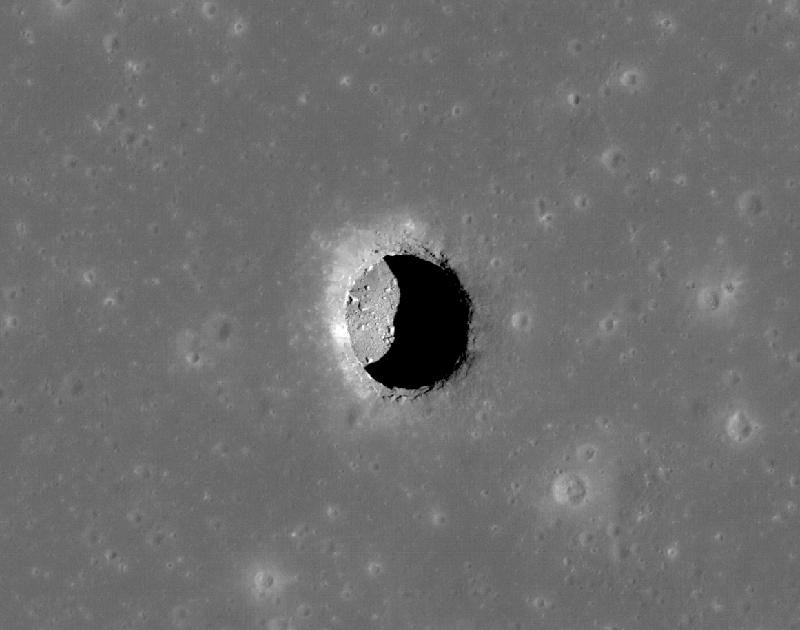
Large caves near the Moon’s equator maintain a stable daily temperature around 17ºC.
Settlements on the Moon have a certain poetic appeal, but scientists have long understood the complications required to achieve this goal. Lack of oxygen, cosmic radiation, and temperature extremes are only a few of the imposing obstacles to this endeavor.
A new study reveals that one hurdle may not be as difficult to overcome as it first appeared. Researchers first identified caves on the Moon in 2009, but the question remained if these features could regulate temperature in the same way caves do on Earth. After more than a decade scanning for temperature anomalies on the lunar surface, a team of researchers at the University of California, Los Angeles and University of Colorado have determined that lunar caves maintain a comfortable 17ºC (63ºF). The results were published in Geophysical Research Letters.
Divining Inspiration
“If you are anywhere on the surface of the Moon, you are subject to huge temperature extremes, cosmic rays, solar wind, and solar radiation, which are difficult to overcome without a significant amount of work,” said Tyler Horvath, a graduate student in the UCLA’s Department of Earth, Planetary, and Space Sciences and first author on the paper. “When the caves were found, we immediately thought, ‘Oh, if we ever want to live on the Moon this would be the easiest place to set something up.’”
For this study, the research team focused on a cylindrical 100-meter–deep pit about the length and width of a U.S. football field, near the Moon’s equator on Mare Tranquillitatis. The pit in this study is one of two that have a visible overhang to a subsurface cave.
To determine the temperature, the team processed images from the Diviner Lunar Radiometer Experiment, a thermal camera that makes up the instrument package on NASA’s robotic Lunar Reconnaissance Orbiter. This task may seem straightforward, but it is actually rather tricky, Horvath said.
Throughout the lunar day, temperatures swing between more than 121℃ to -184℃ (250ºF to -300ºF). According to Horvath, the pit only makes up a small portion, about 20%, of one pixel in the Diviner images. To make sense of conditions in the cave, the team had to reconstruct the actual temperature in the pixel after accounting for spacecraft motion. To do this, they ran computer models to simulate the effect of the spacecraft moving during image capture, and detangled the multiple temperature readings required to create the unique temperature variation.
“We know how Diviner responds to different temperatures and field-of-view,” said Horvath. “By using that information we can determine the temperature of the pit.”
The models using the Diviner data confirmed that the cave maintains a regulated temperature. The team believes that heat is not lost from the pit at night because conduction, or the passage of heat from molecule to molecule, is not terribly efficient. In addition, the prominent overhang at the entryway provides a shadow that blocks incoming solar radiation during the day and prevents heat from slipping away into the night. According to Horvath, the size and depth of the pit also could provide protection from cosmic rays, solar radiation, and micrometeorites.
The team believes the pits are portions of lava tubes that formed as lava flowed along conduits below the surface. As the lava cooled, portions of the hollow tube collapsed, forming an open pit.
Pathways to Exploration
“Studies like this show that our exploration of the Moon has only been the tip of the iceberg,” said Matthew Siegler, senior scientist with the Planetary Science Institute. Siegler did not participate in this study. “With the new SLS rocket launch at the end of the month [August 2022], it is clear that a new ‘Moon race’ is starting up, and maybe it will take explorers to some of these neat places.”
Even if lunar colonization is not in NASA’s immediate plans, results from this study could be beneficial for future rover missions. Mare Tranquillitatis is a huge plain created from multiple flood basalt flows. A rover could study the composition of each layer revealed in the exposed wall of the pit to improve our understanding of the Moon’s evolution.
 EarthSpin