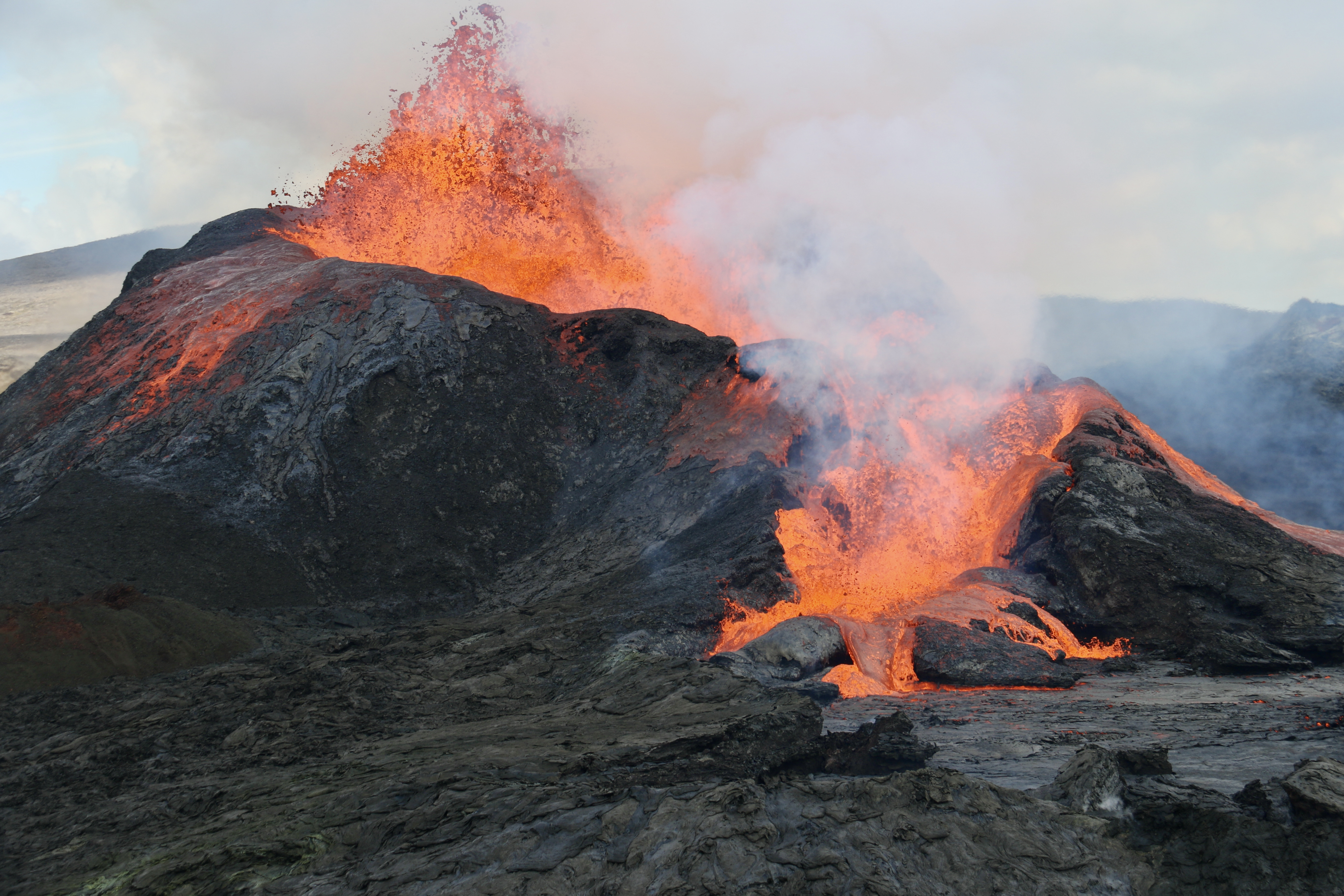
Researchers used satellites and aerial data to create regularly updated maps of the Fagradalsfjall eruption for both the public and disaster response agencies.
On 19 March 2021, the volcano Fagradalsfjall began to erupt, suggesting that volcanoes on Iceland’s Reykjanes Peninsula had awakened from an 800-year slumber. Although most volcanism in Iceland occurs in regions far from population centers, eruptions on the Reykjanes Peninsula can threaten residents.
“Basically, Fagradalsfjall is in the backyard of the capital of Iceland, Reykjavik,” said Gro B. M. Pedersen, a researcher at the University of Iceland. “The peninsula is a rather pristine, young region of Iceland.”
Pedersen and a team of scientists came together to create maps to prepare the public for the evolving events. These mapping efforts were recently published in Geophysical Research Letters.
Mapping an Eruption
According to Pedersen, it was difficult for researchers to predict what would happen during the Fagradalsfjall eruption because they lacked a historical perspective for the region.
Scientists began gathering data using both satellite and airborne images. Although satellites offer ideal coverage of a region, clouds often mar the satellite view of the sky over Iceland. For this reason, the team paired satellite data with aerial photographs collected during 32 photogrammetric surveys. Researchers then used the data to construct topographic maps and monitor how the landscape was changing between surveys. These maps illustrated the ongoing evolution of the eruption.
Pedersen and her colleagues were surprised to see an eruption unlike most on the island. At the start of the event in March, lava began to fill Geldingadalir Valley at a rate of 4 to 8 cubic meters per second. The event concluded in mid-September, having produced a lava field that spanned 4.8 square kilometers with a bulk volume of 150 × 106 cubic meters.
As the eruption progressed, several new fissures opened to the northeast, the discharge rate increased, and the lava began a process of “fill and spill” into neighboring valleys, endangering communication cables, highway access, and sections of hiking paths.
“Just when we thought we were getting the hang of this eruption, another vent would open or another valley would flood,” said Pedersen. “We saw many different styles of activity with the vent. From a volcanologist’s perspective, it was interesting.”
Putting the Maps to Use
Researchers were able to release meter-scale-resolution maps to the public, disaster response agencies, and local police within 3 hours of data collection. The Fagradalsfjall maps offered a window into the ever-changing risks across the region, especially for the thousands of visitors who came to witness the eruption in person.
The experience illustrated how resources can be allocated to optimize mapping and modeling across different communities. For researchers, Pedersen noted the need to build redundancy in their approach to data collection to maintain around-the-clock monitoring of the region.
For residents and visitors, maps can “remind the public that the land beneath them is actually very active and that eruptions can still happen,” said Einat Lev, an associate research professor at Lamont-Doherty Earth Observatory. Lev did not contribute to the study. “Once unrest begins, it is important to make maps and convey the information that is known or anticipated about any potential activity. These must, of course, be updated as more information becomes available and as the event develops.”
 EarthSpin