Spectral data suggest that Kamo‘oalewa, a near-Earth asteroid, has a composition similar to lunar rocks.
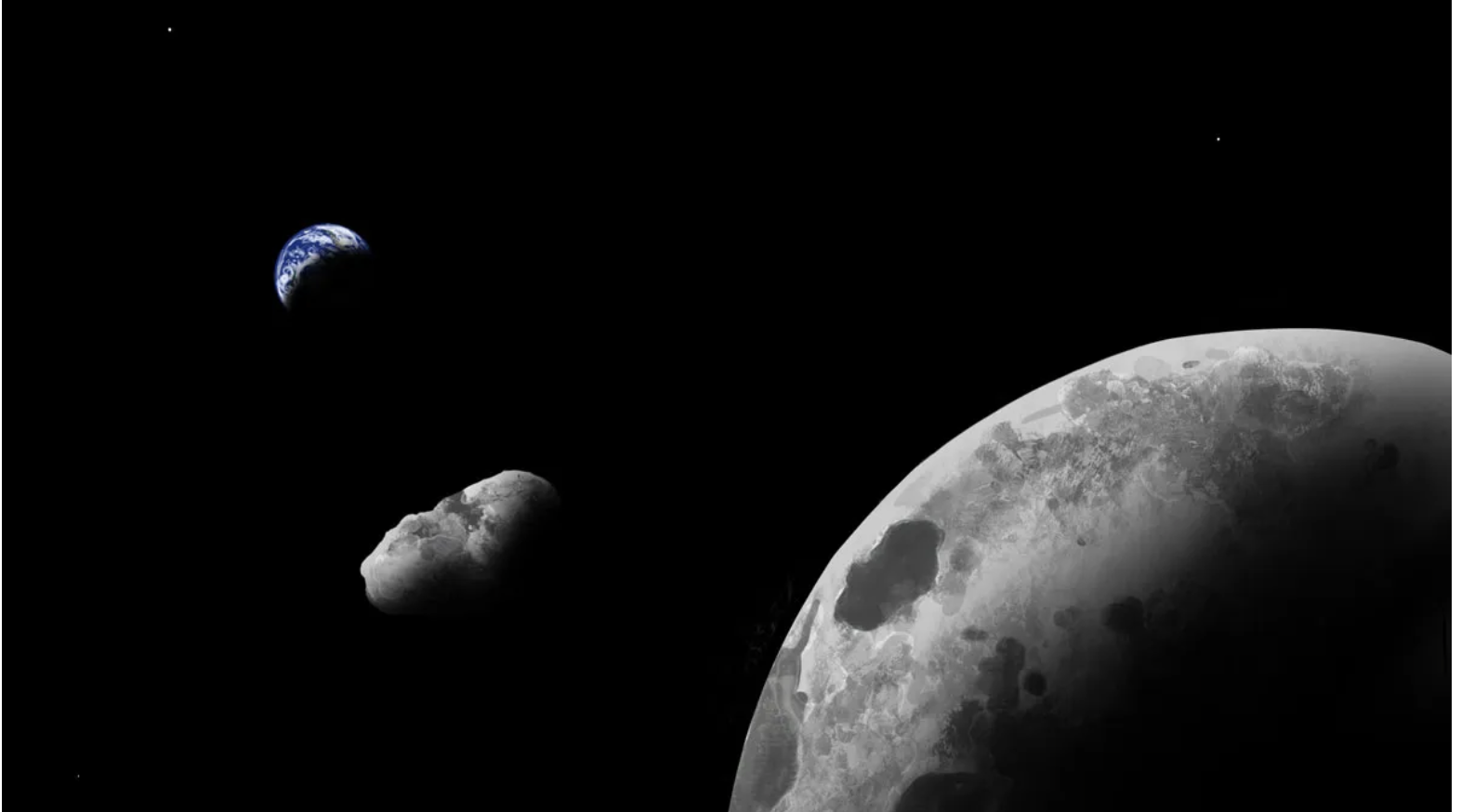
Credit: Addy Graham/University of Arizona
Near-Earth objects are fragments of rock that orbit the Sun along paths that remain close to Earth. Researchers study these objects to assess their threat level but also to improve our understanding of the solar system. Most of these objects are difficult to measure, but one asteroid, Kamo‘oalewa, maintains a stable orbit and makes a regular pass of Earth every April, opening a window to study this chunk of rock in greater detail.
A team of researchers at the University of Arizona have evaluated spectral data collected over several years and have determined that Kamo‘oalewa may actually be a fragment of the Moon. The results of the study were published last month in Nature Communications Earth and Environment.
“What was supposed to be a quick one-and-done summer project turned out to be way more interesting,” said Benjamin Sharkey, a graduate student in the Lunar and Planetary Laboratory at the University of Arizona and lead author on the paper. “As we keep pushing discoveries to fainter things in different parts of the sky, it is exciting to open new populations [of objects] to characterize,” he said. Such analysis allows scientists “to rewind time to explain how the solar system formed and evolved.”
Analyzing an Oscillating Fragment
Kamo‘oalewa was discovered in 2016 by the Panoramic Survey Telescope and Rapid Response System (Pan-STARRS) facilities at Haleakala Observatory in Hawaii. Its name is derived from the Hawaiian and means “the oscillating fragment.” Kamo‘oalewa is relatively large for a near-Earth object, measuring about 46 meters in diameter, and has followed an orbit similar to Earth’s for several centuries. At its closest pass, Kamo‘oalewa travels within 14.5 million kilometers of Earth, more than 37 times the distance between Earth and the Moon. During this limited time, astronomers can make observations on the faint cosmic phantom.
Sharkey and his team gathered data about Kamo‘oalewa using two powerful telescopes in Arizona, the Large Binocular Telescope on Mount Graham and the Lowell Discovery Telescope in Flagstaff. Using these telescopes, they measured the asteroid’s spectrum of electromagnetic radiation to determine its composition.
“We do geology by looking out with telescopes rather than [by] looking down,” explained Vishnu Reddy, an associate professor at the Lunar and Planetary Laboratory and a contributing author on the paper.
The team compared Kamo‘oalewa’s spectral data to stony and chondrite-rich asteroidsand meteorites, as well as to lunar rocks collected during the Apollo 14 mission. Kamo‘oalewa’s reflectance spectrum is redder (indicating higher reflectance at increasing wavelength) than either the asteroids or the meteorites, but when Sharkey compared Kamo‘oalewa’s data to an Apollo 14 lunar rock, it was a match.
“When I first looked at the data, I thought, this is too good to be true,” said Reddy.
But was it?
Reddy encouraged Sharkey to explore every option to explain the spectral data. Reddening, for instance, can be influenced by the angle between a celestial object and the observing telescope. Particle size on the object’s surface, the metal content of surface rocks, and the level of space weathering can also contribute to reddening. Sharkey investigated, and none of those options provided an adequate explanation for Kamo‘oalewa’s spectral data. A lunar match made the most sense.
Maybe a Missing Link
“The general understanding is that near-Earth objects evolved from collisions in the main asteroid belt, and then through gravitational resonances their orbits evolved to be near the Earth,” said Paul Chodas, manager of the Center for Near-Earth Object Studies at the Jet Propulsion Laboratory in California. Chodas did not participate in this study. “This would be the first time we have evidence that an asteroid originated in the Earth-Moon system.”
Reddy and Sharkey wanted to gather more data to confirm these startling results, but the team had to wait 2 years, having lost their opportunity in 2020 because of the pandemic.
Sharkey collected new data in 2021. The new data support the original analysis: Kamo‘oalewa most likely originated on the Moon. How and when it broke free from the lunar surface remains a mystery.
“This could be the missing link between the craters on the Moon and lunar meteorites on Earth,” said Reddy. “We need to conduct follow-up studies to explore other objects in the solar system, but it is exciting to see what is to come.”
 EarthSpin