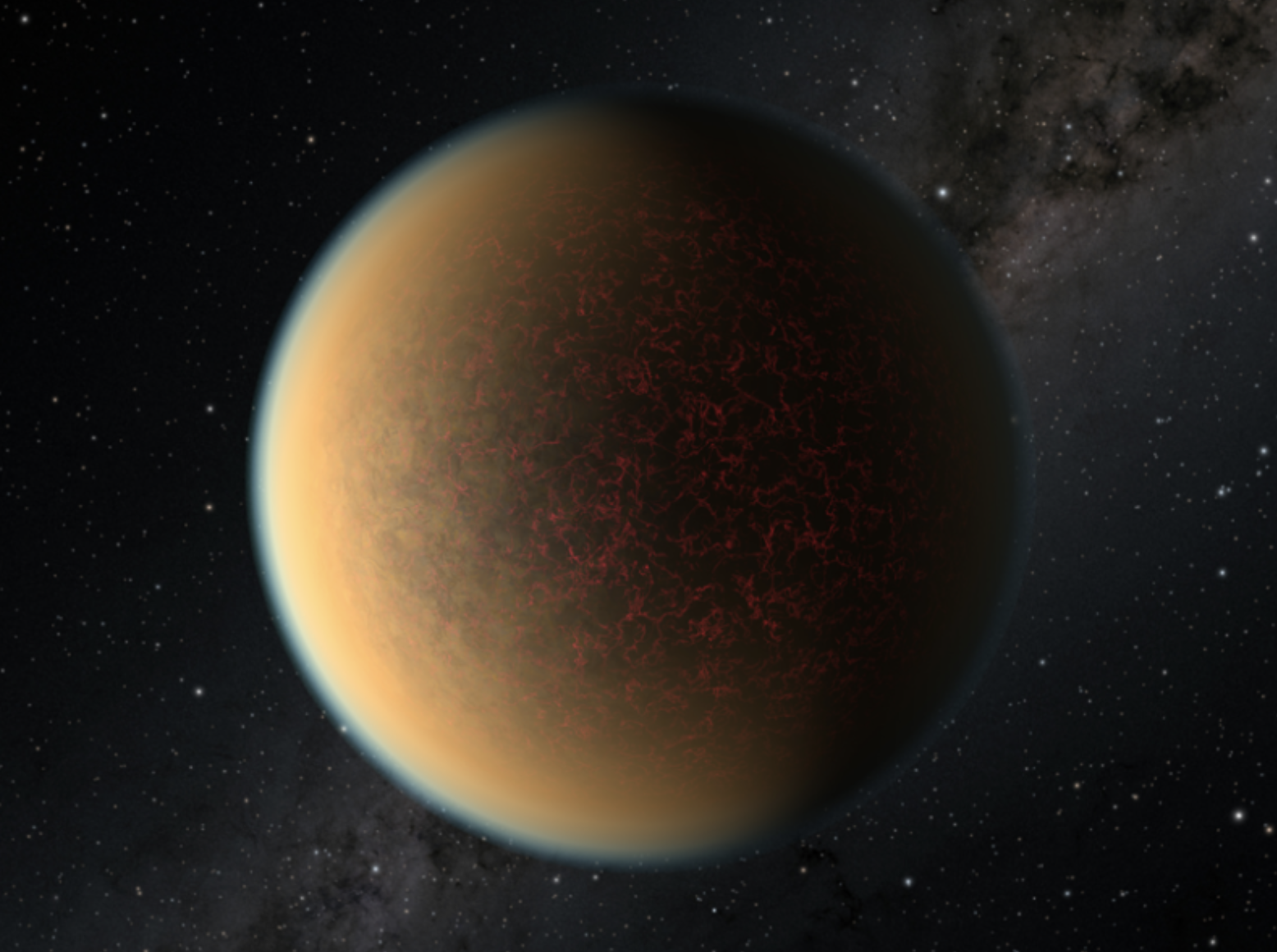
Researchers have long been curious about how atmospheres on rocky exoplanets might evolve. The evolution of our own atmosphere is one model: Earth’s primordial atmosphere was rich in hydrogen and helium, but our planet’s gravitational grip was too weak to prevent these lightest of elements from escaping into space. Researchers want to know whether the atmospheres on Earth-like exoplanets experience a similar evolution.
By analyzing spectroscopic data taken by the Hubble Space Telescope, Mark Swain and his team were able to describe one scenario for atmospheric evolution on Gliese 1132 b (GJ 1132 b), a rocky exoplanet similar in size and density to Earth. In a new study published in the Astronomical Journal, Swain and his colleagues suggest that GJ 1132 b has restored its hydrogen-rich atmosphere after having lost it early in the exoplanet’s history.
“Small terrestrial planets, where we might find life outside of our solar system, are profoundly impacted by atmosphere loss,” said Swain, a research scientist at the NASA Jet Propulsion Laboratory (JPL) in Pasadena, Calif. “We have no idea how common atmospheric restoration is, but it is going to be important in the long-term study of potential habitable worlds.”
The Atmosphere Conundrum
GJ 1132 b closely orbits the red dwarf Gliese 1132, about 40 light-years away from Earth in the constellation Vela. Using Hubble’s Wide Field Camera 3, Swain and his team gathered transmission spectrum data as the planet transited in front of the star four times. They checked for the presence of an atmosphere with a tool called Exoplanet Calibration Bayesian Unified Retrieval Pipeline (EXCALIBUR). To their surprise, they detected an atmosphere on GJ 1132 b—one with a remarkable composition.
“Atmosphere can come back, but we were not expecting to find the second atmosphere rich in hydrogen,” said Raissa Estrela, a postdoctoral fellow at JPL and a contributing author on the paper. “We expected a heavier atmosphere, like the nitrogen-rich one on Earth.”
To explain the presence of hydrogen in the atmosphere, researchers considered the evolution of the exoplanet’s surface, including possible volcanic activity. Like early Earth, GJ 1132 b was likely initially covered by magma. As such planets age and cool, denser substances sink down to the core and mantle and lighter substances solidify as crust and create a rocky surface.
Swain and his team proposed that a portion of GJ 1132 b’s primordial atmosphere, rather than being lost to space, was absorbed by its magmatic sea before the exoplanet’s interior differentiated. As the planet aged, its thin crust would have acted as a cap on the hydrogen-infused mantle below. If tidal heating prevented the mantle from crystallizing, the trapped hydrogen would escape slowly through the crust and continually resupply the emerging atmosphere.
“This may be the first paper that explores an observational connection between the atmosphere of a rocky exoplanet and some of the [contributing] geologic processes,” said Swain. “We were able to make a statement that there is outgassing [that has been] more or less ongoing because the atmosphere is not sustainable. It requires replenishment.”
The Hydrogen Controversy
“I find the idea of a hydrogen-dominated atmosphere to be a really implausible story,” said Raymond Pierrehumbert, Halley Professor of Physics at the University of Oxford in the United Kingdom, who did not contribute to the study.
Pierrehumbert pointed to a preprint article from a team of scientists led by Lorenzo V. Mugnai, a Ph.D. student in astrophysics at Sapienza University of Rome. Mugnai’s team examined the same data from GJ 1132 b as Swain’s did, but did not identify a hydrogen-rich atmosphere.
According to Pierrehumbert, the devil is in the details of how the data were analyzed. Most notably, Mugnai’s team used different software (Iraclis) to analyze the Hubble transit data. Later, Mugnai and his group repeated their analysis using another set of tools (Calibration of Transit Spectroscopy Using Causal Data, or CASCADe) when they saw how profoundly different their findings were.
“We used two different software programs to analyze the space telescope data,” said Mugnai. “Both of them lead us to the same answer; it’s different from the one found in [Swain’s] work.”
Another preprint article, by a team led by University of Colorado graduate student Jessica Libby-Roberts, supported Mugnai’s findings. That study, which also used the Iraclis pipeline, ruled out the presence of a cloud-free, hydrogen- or helium-dominated atmosphere on GJ 1132 b. The analysis did not negate an atmosphere on the planet, just one detectable by Hubble (i.e., hydrogen-rich). This group proposed a secondary atmosphere with a high metallicity (similar to Venus), an oxygen-dominated atmosphere, or perhaps no atmosphere at all.
Constructive Conflict
The research groups led by Swain and Mugnai have engaged in constructive conversations to identify the reason for the differences, specifically why the EXCALIBUR, Iraclis, and CASCADe software pipelines are producing such different results.
“We are very proud and happy of this collaboration,” said Mugnai. “It’s proof of how different results can be used to learn more from each other and help the growth of [the entire] scientific community.”
“I think both [of our] teams are really motivated by a desire to understand what’s going on,” said Swain.
The Telescope of the Future
According to Pierrehumbert, the James Webb Space Telescope (JWST) may offer a solution to this quandary. JWST will allow for the detection of atmospheres with higher molecular weights, like the nitrogen-dominated atmosphere on Earth. If GJ 1132 b lacks an atmosphere, JWST’s infrared capabilities may even allow scientists to observe the planet’s surface. “If there are magma pools or volcanism going on, those areas will be hotter,” Swain explained in a statement. “That will generate more emission, and so they’ll be looking potentially at the actual geologic activity—which is exciting!”
GJ 1132 b is slated for two observational passes when JWST comes online. Kevin Stevenson, a staff astronomer at Johns Hopkins Applied Physics Laboratory, and Jacob Lustig-Yaeger, a postdoctoral fellow there, will lead the teams.
“Every rocky exoplanet is a world of possibilities,” said Lustig-Yaeger. “JWST is expected to provide the first opportunity to search for signs of habitability and biosignatures in the atmospheres of potentially habitable exoplanets. We are on the brink of beginning to answer [many of] these questions.”
 EarthSpin