Researchers in Spain monitored variations in seismic noise across Barcelona as the city locked down during the pandemic, clarifying the seismic band associated with human activity.

In March 2020, countries around the world began to shut down to slow the spread of the coronavirus. Although the measures were preventative and protective, they also offered scientists an opportunity to evaluate how this drastic change rippled throughout the environment. Within a few weeks of the initial lockdown, Spanish scientists recorded a significant reduction in air pollution. Jordi Díaz, part of the scientific staff at Geociencias Barcelona–Consejo Superior de Investigaciones Científicas, and his team used this unique period to create a baseline for seismic noise in urban areas.
In September 2019, seismologists established a network of 14 temporary seismic sensors along with 5 permanent sensors (all placed 2 to 3 kilometers apart from one another) across Barcelona to evaluate different methods to capture ambient noise. What they did not anticipate was that the network would monitor the level of seismic vibrations during this remarkable period in human history. The study offers insight into how seismic monitors could be used to monitor human movement to understand economic activity. The results are available in a special issue of the journal Solid Earth.
“When you hear a piece of music, you do not isolate the strings or the percussion; you hear the whole thing,” said Díaz, lead author on the paper. “Like music, a seismic record is composed of vibrations from many different sources—traffic, earthquakes, ocean waves. We were curious if we could identify changes in the seismic data produced by human activity during lockdown.”
Lockdowns in Spain
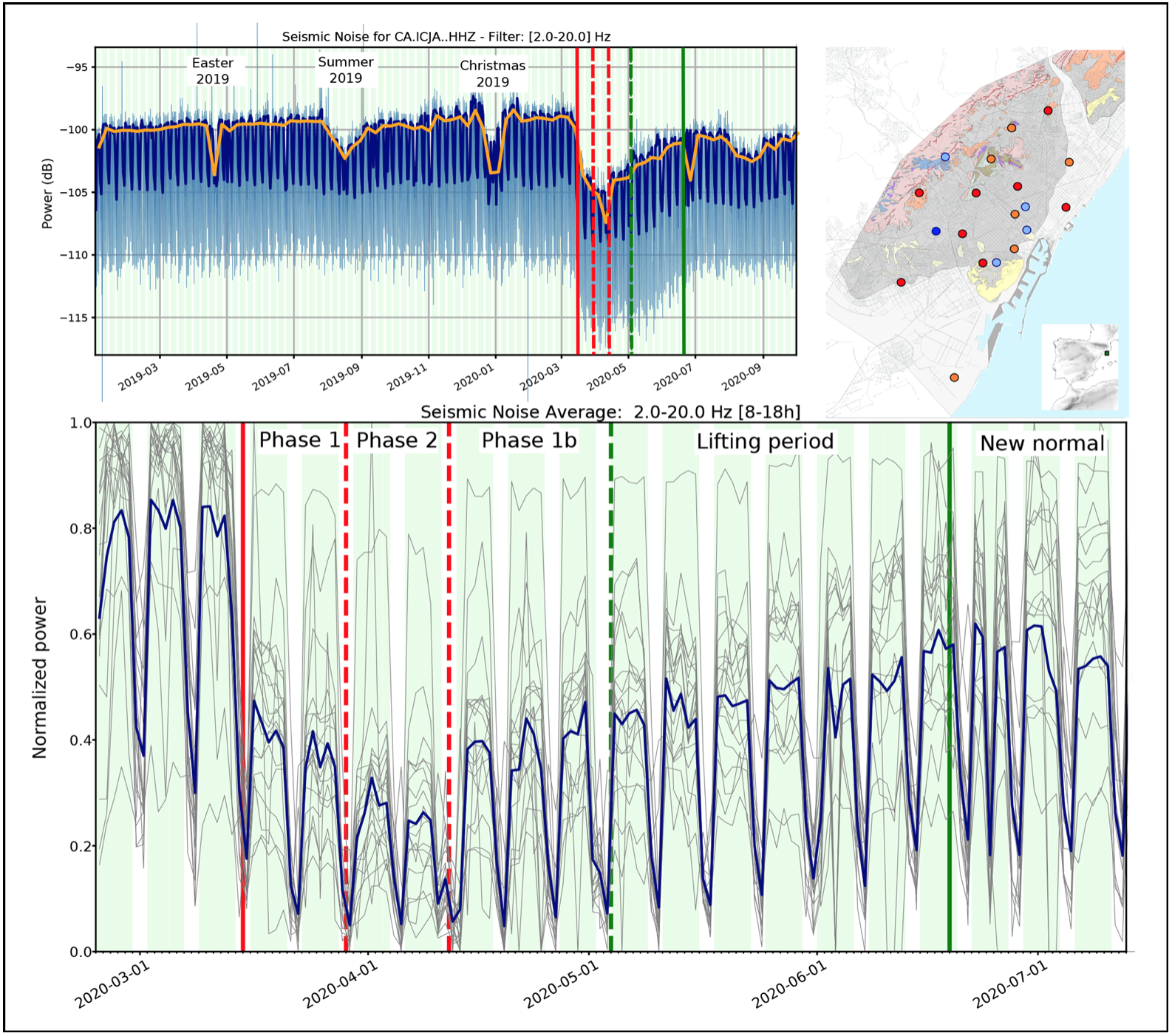
In Spain, phase I lockdown measures began on 15 March 2020, which required people to stay home, except for essential trips to work or the grocery store. Schools were shuttered. Two weeks later, the government issued phase II orders, reducing service, industry, and construction activities. The lockdown restrictions began to ease through the summer months.
Díaz and his colleagues focused on the seismic band between 2 and 20 Hertz, previously associated with human activities. They found that the seismic noise in this band diminished during the lockdown period at all of the seismic stations. Noise power varied between day and night, with the quietest time (approximately 15 decibels lower) between midnight and 5:00 a.m. Even during the day, noise levels were 12 decibels quieter than prepandemic conditions.
Previous studies have shown that a region’s underlying geology plays an important role in the transmission of seismic noise, with sedimentary basins amplifying the transmission of seismic vibrations more effectively than areas underlain by hard rocks. The reduction in human activity during the lockdown clarified the role of geological amplification.
“What is nice in the present study is that with just [a few] sensors, they are able to monitor a whole metropolitan region for noise, as the sensors integrate up the levels,” said Peter Gerstoft, a researcher at the Scripps Institution of Oceanography, University of California, San Diego, who did not contribute to the study. “The difference between industrial and quiet periods is a factor of 10. That is a lot of quieting. Maybe it would be nice to reduce noise in areas all of the time.”
Seismic Data as a Proxy
The researchers attribute the change in seismic noise to reduced traffic and movement in the vicinity of the sensors. The team compared their study results with mobility indicators obtained from apps and cell phone activity logged by tech giants, like Google, Apple, and Facebook. They also compared their results to data obtained from the Barcelona transport authority and mobility data from three mobile phone operators provided by Spain’s National Statistics Institute. The researchers found similar results with all of the other applications.
Díaz and his team believe seismology offers an enticing approach to monitor human activity that is advantageous over mobility indicators that are owned and managed by large corporations. Seismic sensors like the ones Díaz and colleagues used are easy to install and provide data that can be streamed in near-real time. In addition, the traffic and industrial activity are aggregated in the seismic data. The data obtained using the seismic sensors are open source and available to the public. Data gathered with mobility apps are owned by private companies, which own the information and can decide how it can be used.
According to Díaz, many organizations are already turning to seismology and seismic data to monitor everything from ocean storms and seasonal river discharge to economic indicators from human activity.
“Seismic data is open and available to the public,” said Díaz. “It could be a powerful tool that is easy to use and yield practical utility.”
 EarthSpin