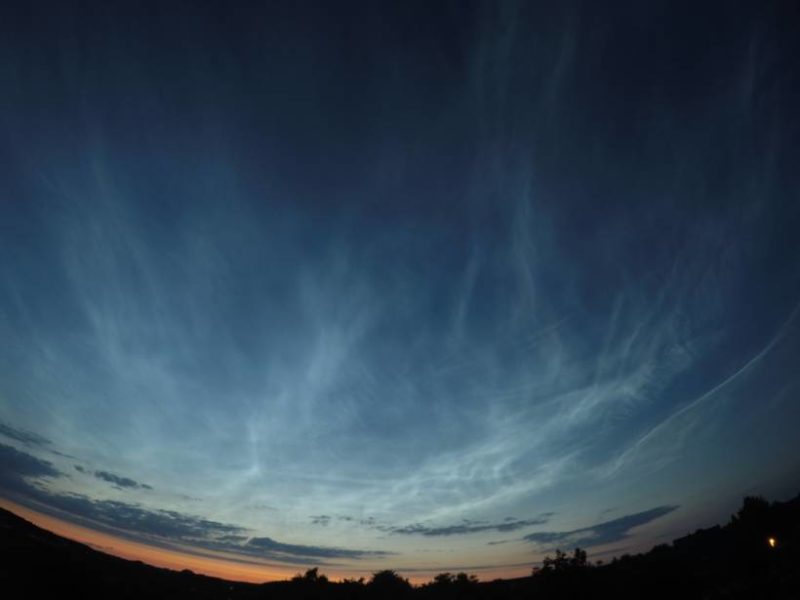
Credit: Gerd Baumgarten, Leibniz-Institute of Atmospheric Physics
High in the atmosphere, noctilucent clouds are ethereal wisps of ice that form along the mesopause, where the mesosphere transitions into the thermosphere. Familiar in the summer polar sky, these clouds are less common at lower latitudes. Kühlungsborn, a small town in northern Germany, lies at the edge where these unique clouds can survive. In 2019, an unusually large number of noctilucent clouds (NLCs) formed over the town in the early summer, many of which lingered in the night sky.
A research team at the Leibniz-Institute of Atmospheric Physics at Rostock University, Germany, set out to understand the atmospheric dynamics that led to this unusual event. The results of the team’s study were published in the March issue of the Journal of Atmospheric and Solar-Terrestrial Physics.
“The [historic noctilucent cloud] data set is one of the very few that reach back 140 years.”“Noctilucent clouds are highly sensitive to temperature and are an interesting tracer for what is going on in the upper mesosphere,” said Michael Gerding of the Leibniz-Institute and lead author of the study. “The [historic noctilucent cloud] data set is one of the very few that reach back 140 years.”
Without trace gas or even direct temperature measurements for most of the historic cloud record, Gerding and his team pulled together direct observations using the latest instrumentation, including lidar, radar, and the Aura and Thermosphere Ionosphere Mesosphere Energetics and Dynamics satellites, to decipher the atmospheric dynamics at play.
Unraveling the Mystery
The first clouds began to coalesce in the sky in the early hours of the morning on 29 May and continued to form through June, resulting in nearly 3 times more NLCs than normal. Even stranger, the clouds persisted. In one instance, a cloud lingered overhead in the atmosphere for more than 10 hours. On average, the clouds formed 600 meters lower than usual in the atmosphere (at 82.2 kilometers) and were unusually bright, producing four of the six brightest noctilucent cloud events on record. As quickly as they appeared, the clouds were gone, with the phenomenon returning to its normal seasonal frequency.
“The signals were strong enough in 2019 to look at the data in high resolution,” explained Gerding. “We can [use this information to] understand the dynamic processes responsible for how noctilucent clouds form and behave.”
Data Are Power
Two factors affect where and when the ice crystallizes: temperature and water vapor supersaturation. The team combined all of the data gathered during the season to create a monthly mean profile to determine the general likelihood of any clouds forming.
The data showed that the atmosphere above Kühlungsborn was significantly colder below 83 kilometers than in any year since 2010. Despite this anomaly, the atmosphere returned to normal or even warmer than normal by 70 kilometers above Earth’s surface.
Although the team lacks the data to make a definitive statement about what caused the unique event in 2019, Gerding noted that the tropopause jet shifted its location from central/northern Europe toward southern Europe. He hypothesized that this shift could have altered local winds to produce more uplift in the upper mesosphere, bringing colder temperatures, more water vapor, and weaker winds into the region.
“This paper is a small study that has huge implications,” said Cora Randall, a distinguished professor at the University of Colorado Boulder and the principal investigator on the Cloud Imaging and Particle Size experiment on the NASA Aeronomy of Ice in the Mesosphere satellite mission. She did not contribute to this study. “It adds a piece to the puzzle that will help answer important questions about how lower-latitude clouds change.”
 EarthSpin