Feeds:
Posts
Comments

Archive for April, 2021

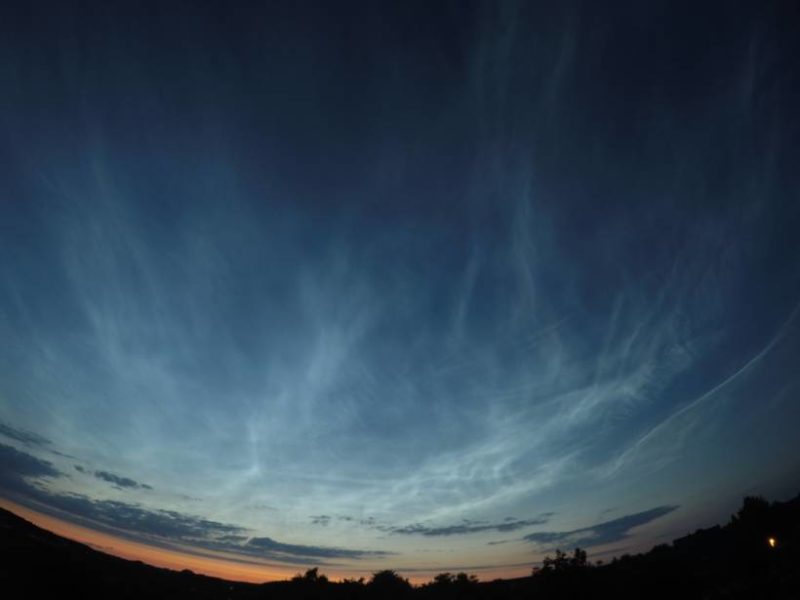
An array of noctilucent clouds formed over Kühlungsborn, Germany, on the evening of 21 June 2019.
Credit: Gerd Baumgarten, Leibniz-Institute of Atmospheric Physics

High in the atmosphere, noctilucent clouds are ethereal wisps of ice that form along the mesopause, where the mesosphere transitions into the thermosphere. Familiar in the summer polar sky, these clouds are less common at lower latitudes. Kühlungsborn, a small town in northern Germany, lies at the edge where these unique clouds can survive. In 2019, an unusually large number of noctilucent clouds (NLCs) formed over the town in the early summer, many of which lingered in the night sky.

A research team at the Leibniz-Institute of Atmospheric Physics at Rostock University, Germany, set out to understand the atmospheric dynamics that led to this unusual event. The results of the team’s study were published in the March issue of the Journal of Atmospheric and Solar-Terrestrial Physics.

“The [historic noctilucent cloud] data set is one of the very few that reach back 140 years.”“Noctilucent clouds are highly sensitive to temperature and are an interesting tracer for what is going on in the upper mesosphere,” said Michael Gerding of the Leibniz-Institute and lead author of the study. “The [historic noctilucent cloud] data set is one of the very few that reach back 140 years.”

(more…)
Read Full Post »

A method using nonpooled, continuous stable carbon and oxygen isotopes recorded in oak trees benefits climate reconstructions.

Thomas Quine, CC BY 2.0 https://creativecommons.org/licenses/by/2.0, via Wikimedia Commons

For decades, the widths of tree rings have offered a precise window into past regional environmental conditions. The oxygen (δ18O) and carbon (δ13C) isotopic signatures of wood cellulose provide an additional, nuanced environmental fingerprint that records subtle shifts in temperature, precipitation, and drought conditions.

Despite the power of this approach, questions remain as to how tree species, site elevation, tree age, and preservation techniques could affect the stable isotopic values captured in the individual samples.

“To reconstruct multimillennial chronologies, samples from living trees, historical timbers, archaeological remains, and subfossil materials have to be combined,” said Otmar Urban, a scientist at the Global Change Research Institute, Czech Academy of Sciences, and first author of a new study on the value of stable isotopes in individual trees. “It could bring problems, because [this information] is usually unknown.”

To address these uncertainties, the researchers developed a new method to evaluate the variability in the stable isotopic record in individual trees. They leveraged a multimillennial tree ring chronology established in the Czech Republic, consisting of about 4,000 core samples obtained from living oaks and historical timbers of the same species. This database provides a mechanism to reconstruct climate conditions across central Europe over the past 1,500 years. The results of the study were published in the February issue of Dendrochronologia.

(more…)

Read Full Post »