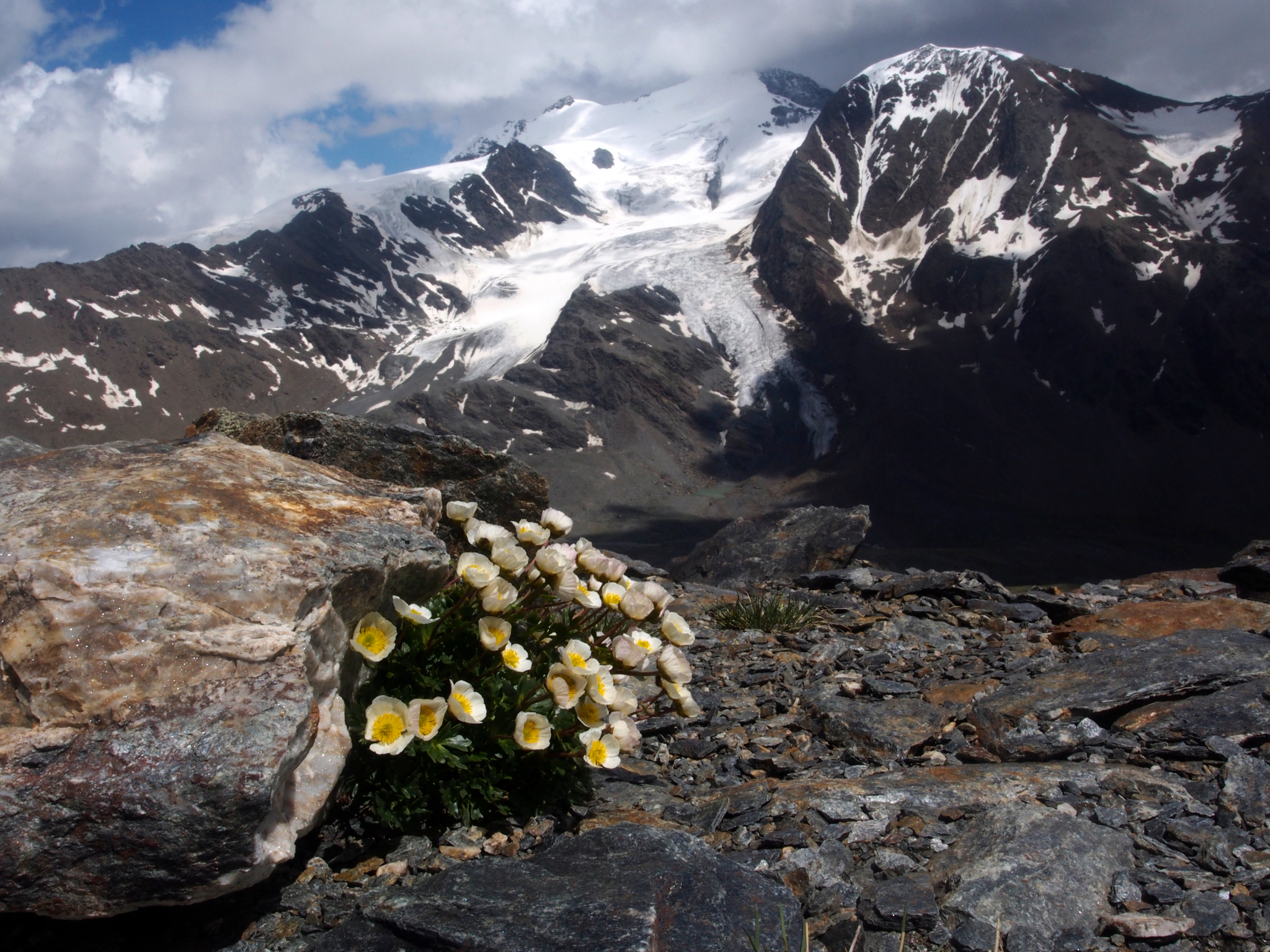
A new study examines the impact of glacial extinction on biodiversity in alpine regions.
Many of the botanicals used in traditional medicines and to flavor spirits, from absinthe to eau de vie, grow in alpine regions near the toes of glacial ice. As the planet warms and glacial ice retreats, this unique environment is changing and altering the diversity of the plant community.
An Italian team of researchers explored the physical and biological factors that cascade through an ecosystem as glaciers retreat. The results, published in the January issue of Frontiers in Ecology and Evolution, are not promising for your favorite flavored liquors.
“Glacial retreat is a double-edged sword,” said Gianalberto Losapio, a postdoctoral research fellow in ecology at Stanford University and first author on the study. “Habitat opens as a direct consequence of losing the glacier, but diversity decreases as competition increases from the species that persist.”
The researchers examined published data sets on plant species distribution and leaf traits along with unpublished, original data on environmental conditions at four locations—Vedretta d’Amola glacier, Western Trobio glacier, Rutor glacier, and the Vedretta di Cedec glacier forelands—within the Italian Alps.
They applied hierarchical joint species distribution models to the data, consisting of 117 plant species, to evaluate how biodiversity changes following glacial retreat. They defined the age of each plant community on the basis of both distance from the glacier front and geochronological information obtained from dated moraines. For instance, a community found between the toe of glacial ice and a moraine dated to 1980 is approximately 20 years old.
Glacial retreat occurs when the ice mass is not balanced, that is, when more ice is lost during the summer months than forms during the winter months. Globally, glaciers have been retreating since the Little Ice Age, about 170 years ago.
Biodiversity Dwindles with Climate Change
The researchers found that the loss of glaciers affects more than half (51%) of plants in the study. As ice retreats, plants initially practice cooperation to enhance collective growth. As time passes, competition increases, leaving fewer dominant plants and decreased biodiversity. This outcome has far-reaching consequences.
More than 20% of the species studied face local extinction. The researchers predicted that the study area will experience more than 10 local extinctions, including Artemisia genipi, commonly called wormwood and a key ingredient in absinthe and génépi.
“As humans, we are so shortsighted, climate change [not only] is negatively affecting…our planet and environment, but also threatens the loss of centuries of cultural traditions as bottled in spirits made from the disappearing wild génépi,” said Brenton Engel, founder of Letherbee Distillers in Chicago.
This study clarifies the dynamics at play as species respond to the rapidly changing environmental conditions as the planet warms. The study’s results will aid conservationists as they work to allocate limited resources in the preservation of key species at risk of local extinction.
“The plants in the study are central for ecological networks, providing food and habitat for pollinators and predators. The loss of these species will cascade through the network, and we could see secondary extinctions,” said Losapio. “These results are incredibly relevant scientifically and for society.”
Citation: Kish, S. (2021), Global warming could rob liquors of their flavor, Eos, 102,https://doi.org/10.1029/2021EO155420. Published on 04 March 2021.
 EarthSpin