A new study at Carnegie Mellon University explores why local perceptions often differ on contentious global issues, like climate change.
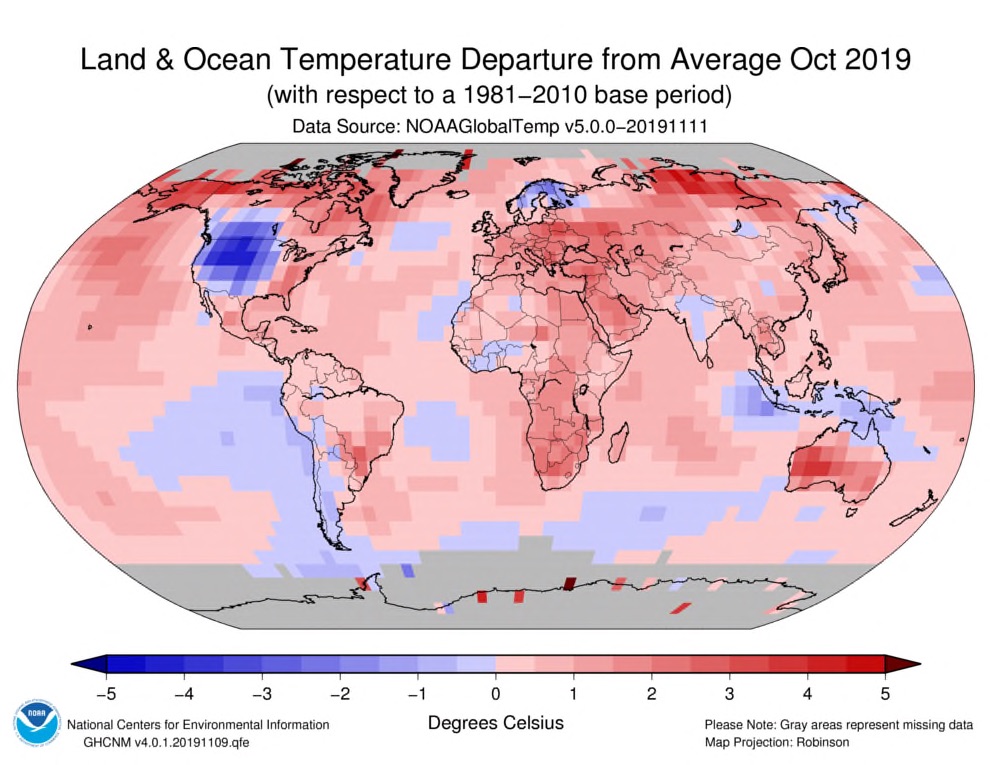
The internet has brought us closer together, but it has also pushed us farther apart. On issues as far reaching as climate change and vaccinations, disparity is growing between scientific consensus and pockets of local doubt.
New research at Carnegie Mellon University explores how a local vantage point can muddle how people understand important global issues. Stephen Broomell leverages measurement theory to reveal an incompatibility between local perceptions and actual global events in his study published in the March 25 issue of Cognitive Science.
“Any large problem that requires consensus can be undermined by random differences between local perspectives,” said Broomell, associate professor in the Department of Social and Decisional Sciences at CMU. “In the presence of random noise, you need global evidence to understand a global issue.”
He adapted classical test theory to explore how people judge complex concepts by using their own observations, such as extreme weather events put forward to support climate change.
“My entire analysis takes place outside of the mind,” said Broomell. “I directly model the environment for its informational content, then show when (and how) cognitive processes are subjected to an external limitation.”
According to Broomell, it is difficult to perceive climate change from weather extremes. The chance of extreme events is something that is very difficult to judge from the local vantage point, which can lead to skepticism concerning climate change.
“One current theory is to make global warming more concrete and come alive by pointing to examples like hurricanes or heat waves,” said Broomell. “My work tries to show that because these concrete events are random in terms of when they occur and who they impact, they may not lead to a public consensus that is converging on the truth.”
If people are being asked to use these extreme examples to appreciate the impact from climate change, then there will always a large portion of the population that does not currently feel the immediacy of the repercussions from the warming, whether it be sea level rise, increased storm severity or drought.
By focusing more on the abstract target of judgement, Broomell hopes to identify ways to unlink these concepts from incompatible local perspectives. The model also offers a way to measure the difference in the perceived reliability and actual reliability of information available.
“I am excited that I can connect many topics with one model,” said Broomell. “I started with a focus on environmental risks, such as climate change, but I found that the results can be used to identify other problems that have a similar incompatibility issue.”
According to Broomell, this work offers risk communicators a new way to approach messaging around global issues. By accounting for local perspectives, they can re-frame the discussion in ways that might be more compelling. It also suggests new opportunities to tag information to help people fact-check and bring clarity to the significance of disparate pieces of data in a noisy information environment. This approach could help people understand complex, global events, even if it differs from what is happening outside the kitchen window.
This approach could be applied to other global issues, including economic and public policies as well as environmental threats. According to Broomell, this study did not examine the influence of social media on local judgements, which would require more complex models to evaluate dynamic feedback.
##
Broomell published the article, titled “Global-Local Incompatibility: The Misperception of Reliability in Judgment Regarding Global Issues,” in the March issue of Cognitive Science. The project received funding from the National Oceanic and Atmospheric Administration.
 EarthSpin