 The magnificent light display in the evening sky has inspired artists, explorers, and dreamers for generations. Scientists are also intrigued by stars, but they use these celestial bodies to illuminate their understanding of the origin of the universe.
“Today, thanks to an array of powerful tools and clever experiments, the stars are telling us more than ever about the evolution of the universe and the creation of the elements needed for life,” said lead author Daniel Kasen of the University of California, Santa Cruz.
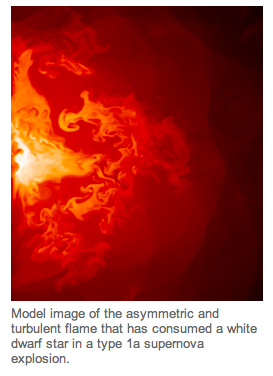
Model image of the asymmetric and turbulent flame that has consumed a white dwarf star in a type 1a supernova explosion.Scientists do not use just any star to investigate the vestiges of time. They focus on Type 1a supernova, white dwarf stars that have exploded.
“When a star is about to go supernova it first begins to simmer, and when the star ignites it is like a fire running through a forest. Eventually the star explodes and what we see is the radioactive debris from the explosion,” said Kasen.
Scientists use the light produced by these supernovae as probes that they call standard candles to determine distances in the universe.
Distance is no small matter, because many scientists believe that the universe is expanding at an accelerating rate. In order to accommodate this expansion they believe that much of the universe is composed of dark energy. But the name does not have menacing implications.
“It is called dark energy, because it is not something that is easily observed,” stated Amber Boehnlein, program manager for Scientific Discovery through Advanced Computing (SciDAC).
In order to study this elusive energy, scientists use the nearly uniform light curve produced by the standard candles like a tool to measure distances, but like any tool, the standard candle must be calibrated.
Past work on this phenomena indicated that the ignition and detonation of the star was not symmetrical, meaning it does not necessarily occur uniformly around the center of the star. So, not all of supernovae burn the same.
“How the star ignites and burns will determine the light curve,” said Kasen. “Like focusing a microscope, a correction must be applied to the standard candle light curve.”
The Computational Astrophysics Consortium is an international group of scientists, mathematicians, and computer engineers assembled to figure out how to tune the standard candle.
The consortium developed a 2-D computer model to simulate these explosive phenomena to produce different light curves in order to understand the processes behind the observed phenomena.
“It is similar to the forensic fire expert that comes on the scene after a fire has been extinguished to identify the ignition points. We take the output from the explosion and work backwards to reconstruct how the star detonated,” said Kasen.
Using the model output, the group of researchers can reconstruct how the star exploded to more accurately use the brightness of the standard candle to determine distance.
“Failing to correct for this effect could lead to systematic overestimates of up to 2 percent in distance” said Kasen. And in space, 2 percent is huge when it comes to determining subtle effects of how the rate of expansion is changing with time.
Light curves of a Type Ia supernova observed in different wavelength bands corresponding to ultraviolet, visible, and infrared light. The solid lines are model predictions while the filled circles are observations of a real event.
The researchers anticipate that these models can be used to refine distance estimates and make measurements of the expansion rate more precise. The computer models were run on Oak Ridge National Laboratory’s super computer “Jaguar” and Lawrence Berkeley National Laboratory’s National Energy Research Scientific Computing Center.
“These efforts illustrate how basic science conducted to understand complex multi-physical phenomena can be applied to a variety of concepts from stars, to forest fires, to even traffic patterns,” said Kasen.
The next step is to address the same question with a 3-D computer model to add another layer of realism to the results.
“This work will help scientists understand not only dark energy, but how it has changed over time in order to constrain the theoretical models of what dark energy actually is,” said Kasen. This work will also help scientists understand the formation of heavy elements, like calcium, silicon, carbon, and iron, the basic building blocks of the life on the planet.
Over the next few years, the group will extend this effort across a broader range of the universe to address significant gaps in scientific understanding, which may influence the construction of planned and future experiments to confront the nature of dark energy.
“Unexpected discoveries fire the imagination and shifts commonly held scientific paradigms. This project will challenge conventional wisdom and take this field to the next step in understanding the origins of the universe,” said Boehnlein.
This study is supported in part by the U.S. Department of Energy (DOE) Office of Science Office of High Energy Physics, Office of Nuclear Physics and Office of Advanced Scientific Computing Research as well as the National Nuclear Security Administration as part of the Scientific Discovery through Advanced Computing program (SciDAC) program.
The computing facilities at Oak Ridge National Laboratory and Lawrence Berkeley National Laboratory are supported by the DOE Office of Science Office Advanced Scientific Computing Research.
This article was written by Stacy W. Kish.
Originally Posted September 21, 2009
http://science.energy.gov/news/featured-articles/2009/09-21-09-s/
 EarthSpin