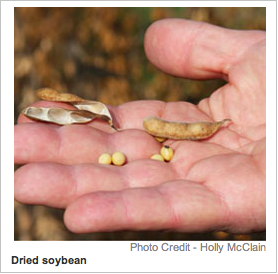
 Soybean is an interesting plant. It provides a valuable protein source for human and animal consumption, it is an important feedstock for biodiesel production, and it interacts with soil-borne bacteria (Rhizobia) that capture atmospheric nitrogen and store it in the soil, a beneficial side-effect utilized during crop rotation. In an effort to unlock the full power of this plant, scientists have sequenced the soybean genome.
“Most people are familiar with sequencing of the human genome,” begins Jeremy Schmutz, faculty scientist at Hudson Alpha Institute for Biotechnology, a partner laboratory with the DOE Joint Genome Institute (JGI). “The soybean genome was sequenced to provide scientists a better understanding of plant productivity, complex biochemical pathways, such as oil production, and pest and pathogen resistance just like the human genome is helping scientists to understand human diseases.”
The scientific team, led by Schmutz, used a process called “whole genome shotgun” to sequence the entire genome as a single effort. “With this technique, we were able to sequence and order the genome at one time so the scientific community could go directly from the genome sequence to breeding new varieties of soybean,” said Schmutz.
At first glance, the soybean genome is an impressive size–1,115 mega-base pairs (Mbp) (1,115,000 base pairs) – about 1/3 the size of the human genome, which contains approximately 3,000 Mbp. But by plant standards, the soybean genome is relatively small and tractable for genomics research.
The soybean genome, like other plant genomes, displays a feature called polyploidy. Schmutz explains, “During seed generation, whole regions of the genome can be duplicated. These duplications can infer a competitive advantage to the plant allowing it to thrive.”
Important traits, like oil production, require complex pathways. A duplication of a section of the genome can allow normal pathways to function, but a mutation may occur along a pathway in a duplicated portion of the genome. This mutation may be the key to giving the plant an added boost to survive and thrive.
The team determined that soybean underwent two large-scale genome duplication events approximately 59 and 13 million years ago.
The implications of the soybean genome sequence for energy and agriculture are enormous. The soybean genome will allow rapid identification of the underlying genetic basis of many soybean traits that are favored in traditional breeding programs. “The soybean genome sequence will help breeders and geneticists understand how they have tweaked the soybean genome during traditional breeding to impart higher oil production and disease resistance,” said Schmutz.
The sequence is available in the public domain, which Schmutz hopes will promote scientific collaboration to improve soybean varieties and bring benefits to market faster. “Mining the soybean genome for pathways involved in triacylglycerol [oil] biosynthesis, for example, could prove beneficial in efforts to modify soybean oil composition or content” said Schmutz.
This research is already having an impact. Expressed plant traits have been associated with particular causal genes to develop soybean lines that improve an animal’s ability to digest soybean, reduce the concentration of phosphorus-rich compounds in animal excretion that are responsible for contamination of freshwater systems from agricultural runoff, and assist in the identification of resistance genes for devastating diseases, like Asian Soybean Rust, which will benefit the soybean production worldwide.
Finally, the draft genome sequence offers new opportunities to identify genes associated with increased biodiesel production, which may one day make the product a competitive alternative to gasoline. The sequence may also provide opportunities to manipulate the plant’s ability to fix nitrogen to ensure soil fertility, especially for bioenergy crop sustainability.
Funding for the draft soybean genome sequence and analysis was provided by the U.S. Department of Energy Joint Genome Institute (DOE JGI), the U.S. Department of Agriculture-Agricultural Research Service (USDA-ARS), the National Science Foundation (NSF), and the United Soybean Board. The project included collaborators from the University of Missouri, Purdue University, and a dozen other institutions.
This article was written by Stacy W. Kish
Originally Posted February 3, 2010
http://science.energy.gov/news/featured-articles/2010/02-03-10-s/
 EarthSpin