 The ocean is teeming with life. But this life teeters on the delicate balance between the creation and destruction of organic carbon. Like green plants on land, algae and bacteria in the surface waters of the ocean combine nutrients, water, and carbon dioxide in the presence of sunlight to fix organic carbon in the form of biomass. This organic carbon, directly or indirectly, provides food for all life in the ocean and is a key part of the carbon cycle.
In regions of the ocean where water circulation is constrained and nutrient input is high the consumption of organic carbon results in severe oxygen depletion producing an oceanic feature known as an oxygen minimum zone (OMZ). Without oxygen, organisms living in these zones suffocate or migrate away, leaving the region a ‘dead zone.’ Global warming is thought to exacerbate this process, allowing OMZ ‘dead zones’ to grow in volume and intensity with potentially harmful consequences to life in the ocean and the health of the planet – at least as we know it.
Although these regions may appear ‘dead’ for lack of larger, more complex organisms, an OMZ is actually teeming with microbial life. These tiny organisms have developed alternative methods to survive and thrive in the oxygen-deficient waters. In the absence of oxygen, these microbial communities use nitrate to break down the organic carbon.
“Microbes in the dead zone literally breathe nitrate, sulfur and metals instead of oxygen,” said Steven Hallam, assistant professor of the Department of Microbiology and Immunology, University of British Columbia, and Canada Research Chair in Environmental Genomics.
During a process called denitrification, nitrate is transformed to nitrogen gas, the harmless, relatively non-reactive nitrogen that makes up the majority of the atmosphere. Denitrification depletes biological nitrogen from the ocean water, but when this process is not complete, it releases a powerful greenhouse gas (nitrous oxide) into the surrounding water.
“This process results in two problems in the ocean — the microbial community is drawing down nitrate, an important nutrient, and potentially releasing a greenhouse gas more potent than carbon dioxide or methane,” said Hallam.
In order to fully understand, model, and manage OMZ expansion, it is important to understand the microbial communities that make up the oxygen minimum neighborhood. Microbial communities, as they exist in nature, are generally too complex to culture or ‘grow’ and study in the lab. Environmental genomics, also known as metagenomics, provides an end run around this complication by directly capturing information about the metabolic potential of indigenous microbial communities.
“Metagenomics is our entry point into the infinitely diverse microbial world,” said Hallam. “The idea is to tap into natural population structure and dynamics of microbial communities to understand how the system as a whole responds to environmental perturbations.”
Metagenomics enables scientists to take an environmental sample, in this case ocean water, and sample the genomes of millions to billions of microbes at the same time. At this point, the sleuthing begins. “Reassembling the segments of the genetic material, finding genes, and reconstructing metabolic pathways in a sample is akin to reconstructing millions of jigsaw puzzles that have been torn apart by a hurricane” said Hallam. “It’s a Humpty Dumpty challenge — putting the genomic pieces back together again in a way that yields meaningful and translatable scientific insight.”
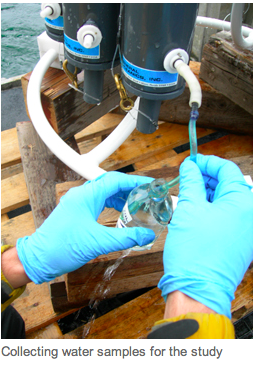
The research team collected water samples from Saanich Inlet, British Columbia as part of the first large-scale microbial genome analysis of an OMZ region. The Saanich Inlet naturally experiences a seasonal oxygen minimum zone every year. In addition, the region has been part of seasonal studies for more than 100 years. “This system is a natural laboratory to study microbial communities” said Hallam.
During OMZ formation in Saanich Inlet, one bacterial group in particular stood out. This group, known by the simple moniker SUP05, reached up to 40 percent of total bacterial abundance in the water column. Interestingly, SUP05 harbors a versatile repertoire of genes that allows it to thrive under a range of water column oxygen, nitrate, and sulfide concentrations.
This project allows the researchers to address questions concerning oxygen minimum zones at a smaller scale that then can be taken to the open ocean to understand the larger global picture. By understanding microbial metabolism at a community level, scientists can reconstruct how carbon dioxide, sulfur compounds, and nitrates are processed and move between the ocean and atmosphere.
“Right now humanity is forcing the biosphere in extreme ways that have the potential to push Earth systems well beyond the set points needed to sustain our way of life. Metagenomics provides a set of tools and ideas to help us constrain and monitor microbial community contributions to carbon sequestration, ocean acidification, and nitrogen loss in the changing global ocean,” concludes Hallam.
Currently naturally occurring OMZs can be found throughout the Eastern North Pacific Ocean, Eastern South Pacific Ocean, Northern Indian Ocean, and shallow waters along the Southwest African coast. Excess nutrients supplied by agricultural run-off are also leading to extreme oxygen-deficiency along coastlines and in estuaries around the world.
To watch a video on how the scientists collect ocean water, visit www.jove.com/index/Details.stp?ID=1159 .
.
This project received partial funding through the Department of Energy (DOE) Office of Biological and Environmental Research program. The DOE Joint Genome Institute conducted integrated high-throughput sequencing and computational analysis for systems-based scientific approaches to these challenges. To learn more about DOE and JGI, visit www.energy.gov and www.jgi.doe.gov.
Operational support was obtained through the Natural Sciences and Engineering Research Council (NSERC) of Canada, Canada Foundation for Innovation, Canadian Institute for Advanced Research (CIFAR) and the TULA foundation funded Centre for Microbial Diversity and Evolution (CMDE). To learn more about the CMDE, visit www.cmde.science.ubc.ca/.
This article was written by Stacy W. Kish.
Originally Posted November 23, 2009
http://science.energy.gov/news/featured-articles/2009/11-23-09-s/
 EarthSpin