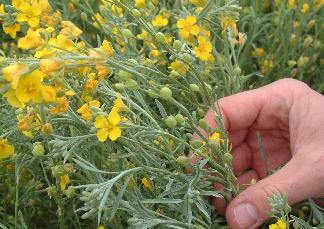
 While consumers are lately hearing a lot about corn-based ethanol, a group of scientists advocates using mustard as a lotion, paint, biodiesel additive and lubricant.
With funding from USDA’s Cooperative State Research, Education, and Extension Service (CSREES), a research group in Texas, Arizona and Illinois is looking at Lesquerella, a member of the mustard family, as a potential source for energy.
Lesquerella (Lesquerella fendleri) grows naturally in arid and semi-arid landscapes and is native to areas in the southwest United States and Mexico. The plant produces seeds that are slightly smaller than alfalfa, but hold a powerful resource: a unique vegetable oil rich in hydroxy fatty acids.
Seed oil is used in a wide array of products, including lithium greases, polymers in paints and coatings, base stocks as lubricants, and applications in the personal care industry. Researchers are excited about the potential of lesquerella because the current source of hydroxy fatty acids is imported castor, which contains the toxic chemical ricin.
Mike Foster and colleagues at Texas A&M University, University of Arizona, USDA’s Agriculture Research Service (ARS) in Maricopa, AZ, and Peoria,IL, and Terresolve Technologies Ltd. have worked to develop new products derived from lesquerella seed oil and market them to a wider audience. The group collected seed from native populations across the United States and Mexico and evaluated their use in the program’s breeding program. The research team developed new breeding lines to increase hydroxy fatty acids and oil content. In addition, they publicly released a salt tolerant line of lesquerella.
Lesquerella has several novel properties absent in other oilseeds. The oil contains natural, unique molecules (estolides), which are rare in other seed oils. These molecules promote natural ease of flow of the oil under many different conditions. Naturally occurring estolides allow lesquerella oil to flow more easily than petroleum at cold temperatures.
Lesquerella provides an agricultural alternative to petroleum that can grow successfully in less productive environments and support rural economies. This project may yield new industrial products from renewable raw materials and expand on market opportunities for farmers and rural communities.
The Department of Energy is evaluating lesquerella oil products as bio-diesel additives. In addition, studies show that the high level of hydroxy fatty acids in lesquerella increases oil lubricity as compared to other vegetable oils. A private company, Technology Crops International, plans to market lesquerella oil, which could result in a huge market for growers in the Southwest.
Extension specialists met with growers in Arizona and Texas to outline specific production practices for successful lesquerella production. Production budgets were developed in cooperation with industry and growers and then compared to budgets for competing crops to show the value of lesquerella.
CSREES funded this research project through the Initiative for Future Agricultural and Food Systems (IFAFS) program. Through federal funding and leadership for research, education and extension programs, CSREES focuses on investing in science and solving critical issues impacting people’s daily lives and the nation’s future. For more information, visit http://www.csrees.usda.gov.
Originally Posted July 31, 2008
http://www.nifa.usda.gov/newsroom/impact/2008/nri/07311_lesquerella.html
 EarthSpin