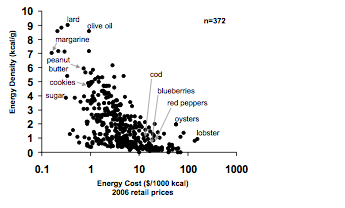
 Recent studies show that the cost of high-calorie foods are less likely to be affected by inflation and, on average, cost less than low-calorie foods. With obesity plaguing the United States, this trend may hinder low-income families from adopting a low-calorie diet. Funding from USDA’s Cooperative State Research, Education, and Extension Service (CSREES) enabled researchers at the University of Washington to examine the price trends of different food choices.
Adam Drewnowski, director of the Center for Public Health and Nutrition at the University of Washington, and colleagues checked the prices of 372 foods sold at local supermarkets in the Seattle area, comparing the prices with calorie density. High-calorie foods included items like peanut butter and granola, while the lowest-calorie foods were mostly fresh fruits and vegetables.
Defined this way, low-calorie foods tend to be rich in nutrients like vitamins and minerals. Conversely, high-calorie foods are rich in calories, but tend to be low in nutrients. The study found that lower-calorie foods cost more per calorie, while more calorie-dense foods showed a lower cost per calorie. Bargain shoppers get a better deal purchasing high-calorie foods rather than low-calorie foods. This study then explored the effect of inflation on the lower- versus higher-calorie foods.
The researchers found the price of calorie-dense food was less likely to rise as a result of inflation. During the 2-year study, the price of high-calorie food decreased by 1.8 percent, whereas the price of low-calorie foods increased by 19.5 percent. Considering most bargain shoppers are trying to stretch their incomes as far as possible, the findings may help explain why the highest rates of obesity are among people in lower-income groups.
Based on a standard 2000-calorie diet, the researchers found a diet consisting primarily of calorie-dense foods costs $3.52 a day, but a diet consisting primarily of low-calorie food costs $36.32 a day. The average American eats a variety of foods throughout the day, spending $7 a day.
“If you have $3 to feed yourself, your choices gravitate toward foods which give you the most calories per dollar,” Drewnowski said. “Not only are the empty calories cheaper, but the healthy foods are becoming more and more expensive. Fresh vegetables and fruits are rapidly becoming luxury goods.”
Those facts may better explain the popularity of calorie-dense foods in the food selection patterns among groups with limited economic resources. Nutrition education programs can address this challenge and provide additional help for planning healthy meals.
The USDA’s Cooperative State Research, Education, and Extension Service (CSREES) funded this research project through the NRI Human Nutrition and Obesity program. Through federal funding and leadership for research, education and extension programs, CSREES focuses on investing in science and solving critical issues impacting people’s daily lives and the nation’s future. For more information, visitwww.csrees.usda.gov.
Originally Posted March 19, 2008
http://www.nifa.usda.gov/newsroom/impact/2008/nri/03191_food_prices.html
 EarthSpin