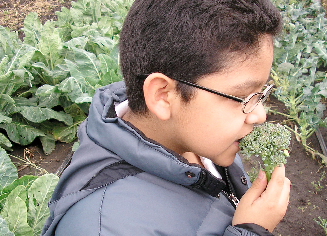
 Improving the nutritional value of school meals is a growing priority among school systems across the United States. In an effort to provide a solution for school administrators, the USDA’s Cooperative State Research, Education, and Extension Service (CSREES) funded a coalition of school districts and farmers from four states to participate in a new program called “From Farm to School: Improving Small Farm Viability and School Meals.”
Farm to school programs connect schools with local farms to improve the nutrition of school meals, provide agriculture and health education, and support local farmers. The “Farm to School: Improving Small Farm Viability and School Meals” project has been a powerful catalyst to establish farm to school programs as a model to address the diet-related health issues of children while supporting small and medium-scale farmers. The program’s model allows schools to buy and feature farm fresh foods, such as fruits and vegetables, eggs, honey, meat and beans on their school lunch menus.
The project initiated the collaborative framework that helped establish the National Farm to School Network with organizations in more than 38 states to support the expansion of regionally and locally appropriate farm to school models.
Anupama Joshi of the National Farm to School Program in collaboration with project partners tackled the most common challenges of distribution, farmer capacity and school implementation costs to launch successful farm to school programs in California, New York, New Jersey and Pennsylvania.
As a result of the farm to school approach, lunch participation and fruit and vegetable consumption by students increased. Program leaders noted that students consumed 100 to 162 percent of the USDA daily requirements for fruits and vegetables at two sites in California.
In the three pilot programs initiated in California, elementary schools purchased local and in-state products with increased sales over time. The Yolo County and Ventura County farmers participating in the program benefited directly from the sale to schools. One farmer noted that up to 40 percent of sales were attributed to a local school district. A survey of 370 New York school food service directors showed that 25 percent purchased directly from farmers and 72 percent purchased foods from a farmer/vendor.
A nutrition-based curriculum was incorporated in the pilot schools, educating students through farm visits, gardening and recycling programs. In addition to providing a new market to increase farmers’ revenue, the program connected farmers to their community through participation in programs designed to educate kids about local food and sustainable agriculture.
During the project period, the number of operational farm to school programs expanded from six pilot districts to more than 400 programs nationwide in 2004. Currently, more than 1000 programs are operational in 38 states. Policy changes in the 2004 Child Nutrition and Women Infants and Children Reauthorization Act have incorporated the provisions supportive of farm to school programs. More than 16 states have passed legislation to support farm to school programs with pending bills in additional states.
The USDA’s Cooperative State Research, Education, and Extension Service (CSREES) funded this research project through the Initiative for Future Agricultural and Food Systems (IFAFS) program. Through federal funding and leadership for research, education and extension programs, CSREES focuses on investing in science and solving critical issues impacting people’s daily lives and the nation’s future. For more information, visit www.csrees.usda.gov.
Originally Posted July 29, 2008
http://www.nifa.usda.gov/newsroom/impact/2008/nri/07291_farm_to_school.html
 EarthSpin