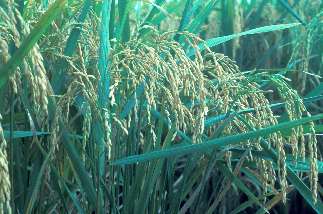
 In 2008, headlines of real world events read like the script of a bad science fiction movie – the main food source of half the world was in short supply, sparking riots around the globe. But new research may help shield rice crops from future attacks.
Rice is a tiny cereal grain that is the primary source of food for more than 50 percent of the world’s human population. It is the second most consumed cereal grain and provides more than one-fifth of the caloric intake of people around the world. Fearing a global shortage, many governments and retailers began rationing rice supplies, which led to the events in the headlines.
The importance of this grain to the world community is clear. It is also important to science; the rice genome was one of the first cereal crops sequenced.
Scientists use rice as a model for research of other cereals because it has a relatively small genome compared to other cereals. The diminutive rice genome is one-sixth the size of the maize genome and 40 times smaller than the wheat genome. The complete sequence of the domesticated rice variety, Oryza sativa spp. japonica, was finished in 2004.
Despite all of the progress in mapping the rice genome, the function of individual rice genes lags far behind the same studies in other cereal crops. Now, with funding from USDA’s Cooperative State Research, Education, and Extension Service (CSREES), scientists in California have cataloged the different techniques available to determine the function of genes in rice.
Pamela Ronald and colleagues at the University of California–Davis and Postech, Korea, provide a complete analysis of all of the tools and publically available collections for this important agricultural crop to the scientific community. These tools will help scientists delve into the rice genome and discover the function of the estimated 41,000 rice genes.
“[The] tools include rice lines that are lacking function of one or more genes, methods for assaying the expression of genes in different environments, and databases to catalog rice gene function,” Ronald said.
A genome, the total of all genes that make up the genetic code of an individual, is like a brick building where genes are the individual bricks in the building. A gene is the basic unit of inheritance.
Currently, the scientific community has identified forms of genes that confer fungal and bacterial resistance, as well as genes that make the grain tolerant of submergence and other stresses. Genes responsible for flowering, nutrient transport, and biochemical pathways play a critical role in plant growth and development, as well as establish the environmental parameters under which the crop thrives.
Research on gene function may provide additional protection to the rice crop from attack from bacterial, fungal, and insect pests. Deciphering gene function may also increase plant growth, crop production. and expand the plant’s environmental tolerance, allowing it to thrive under a new set of conditions dictated by changing climate, including drought, flood, and increased carbon dioxide concentrations.
For example, a gene called Sub1 has already been used to develop new rice varieties that are tolerant to submergence, a problem that affects 75 million poor farmers in south and southeast Asia. These Sub1 varieties, developed in collaboration with breeders at the International Rice Research Institute, are now showing dramatic gain yields in farmers’ fields in Bangladesh.
Deciphering the function of genes in the rice plant will ensure the supply remains bountiful in the future. The knowledge gained from these studies can be transferred to other important cereal crops as well as bioenergy crops, such as switchgrass.
CSREES funded this research project through the National Research Initiative Plant Genome program. Through federal funding and leadership for research, education and extension programs, CSREES focuses on investing in science and solving critical issues affecting people’s daily lives and the nation’s future. For more information, visit www.csrees.usda.gov.
Originally Posted February 17, 2009
http://www.nifa.usda.gov/newsroom/impact/2009/nri/02171_rice_gene.html
 EarthSpin