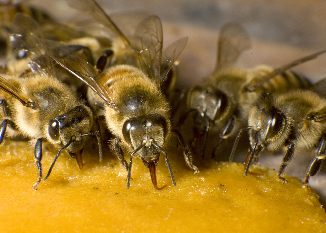
 Colony Collapse Disorder (CCD) has been linked to the 40-60 percent decline in America ‘s honeybee populations whose pollination is valued at $15 billion annually to U.S. agriculture. Researchers at SAFE R&D, LLC, are trying a new approach to this problem – a bee smoothie – to improve honeybee healthy by improving their diet.
With funding from USDA’s Cooperative State Research, Education, and Extension Service (CSREES), Dr. Gordon Wardell, president of SAFE R&D, LLC., and his research partner Fabiana Ahumada-Segura developed MegaBeeTM as a nutritional supplement for honeybees that contains protein, lipids, balanced amino acids and other nutrients that support healthy hive development.
The pair believed that a severely restricted diet, brought on by the policy of commercial beekeepers to limit a hive’s range to one type of crop, might have led to nutritional deficiencies within honeybee populations.
An independent study completed in 2007 compared the effectiveness and efficiency of MegaBee to conventional sugar syrup. The study found that brood production rates in honeybees consuming the MegaBee supplement tripled. In addition, colonies fed MegaBee retained 30 percent more adult bees, more efficiently converted food to the brood, had greater adult bee populations, and were better able to pollinate.
MegaBee mimics the natural texture and consistency of pollen and is readily consumed by honeybees. The product is supplied to the beekeeper as a powder, which can be fed to the bees in moist cakes that resemble cookie dough or as a liquid that resembles a smoothie.
“It’s a very nutritional diet for the bees,” said Wade Fisher, a third-generation commercial pollinator who recently began using the MegaBee supplement in Florida and several New England states.
Climate change is forcing earlier than normal floral bloom in many plants, including domesticated plants of agricultural significance. This change of floral cycle significantly affects the bees. In addition, several important agricultural crops, like almonds, naturally bloom in the middle of winter. Colonies have to be stimulated to produce the number of bees necessary to do an adequate job of pollinating these early season crops.
“Supplemental food for our bees is not just recommended today, it’s mandatory,” Wardell said.
MegaBee is produced and marketed by Yuma, Ariz.,-based Castle Dome Solutions, LLC, in partnership with Hamilton, Ill.-based Dadant and Sons, Inc., as a product for commercial and hobbyist beekeepers. Castle Dome started manufacturing MegaBee in September 2007.
CSREES funded this research project through the Small Business Innovation Research (SBIR) program. Through federal funding and leadership for research, education and extension programs, CSREES focuses on investing in science and solving critical issues impacting people’s daily lives and the nation’s future. For more information, visit www.csrees.usda.gov.
Originally Posted September 8, 2008
http://www.nifa.usda.gov/newsroom/impact/2008/sbir/09081_megabee.html
 EarthSpin